11) 2026
F-16 40,000 Flight Hours.
How F-35 Tech Turned the ‘Old’ F-16 Into a New Killer Jet
Edwards AFB F-16C 88-456 with its special 50th Anniversary Fighting Falcon tail flash flies over the desert of Southern California. This Viper is assigned to the 416th Flight Test Squadron, flown by outgoing 416th FLTS Commander Lt. Col. Michael Pacini on his last flight with the Skulls. (Air Force photo by Todd Schannuth)Edwards AFB F-16C 88-456 with its special 50th Anniversary Fighting Falcon tail flash flies over the desert of Southern California. This Viper is assigned to the 416th Flight Test Squadron, flown by outgoing 416th FLTS Commander Lt. Col. Michael Pacini on his last flight with the Skulls. (Air Force photo by Todd Schannuth)
Summary – Born in the 1970s, the F-16 should be aging out. Instead, a sweeping Service Life Extension Program and F-35–grade tech have effectively rebuilt the jet for modern war.
-Structural upgrades and new systems push service life toward 12,000 hours, while an AESA radar lets pilots track dozens of targets at far greater ranges.
Three U.S. Air Force F-16 Fighting Falcons assigned to the 31st Fighter Wing at Aviano Air Base fly in formation during Exercise Combined Strike 25 along the coast of Italy, August 18, 2025. Integration flying training is key to enhancing interoperability with NATO partners and increasing our readiness capabilities. (U.S. Air Force photo by Senior Airman Zachary Jakel)
Three U.S. Air Force F-16 Fighting Falcons assigned to the 31st Fighter Wing at Aviano Air Base fly in formation during Exercise Combined Strike 25 along the coast of Italy, August 18, 2025. Integration flying training is key to enhancing interoperability with NATO partners and increasing our readiness capabilities.
-A revamped cockpit, added automation, and the F-16V’s high-def displays, new data bus, EW suite, and helmet cueing all sharpen lethality.
-With passive IRST sensors giving it another way to hunt in a jammed environment, today’s F-16 is a legacy airframe with a very non-legacy bite.
From 1970s Relic to Digital Fighter: The F-16’s F-35 Makeover
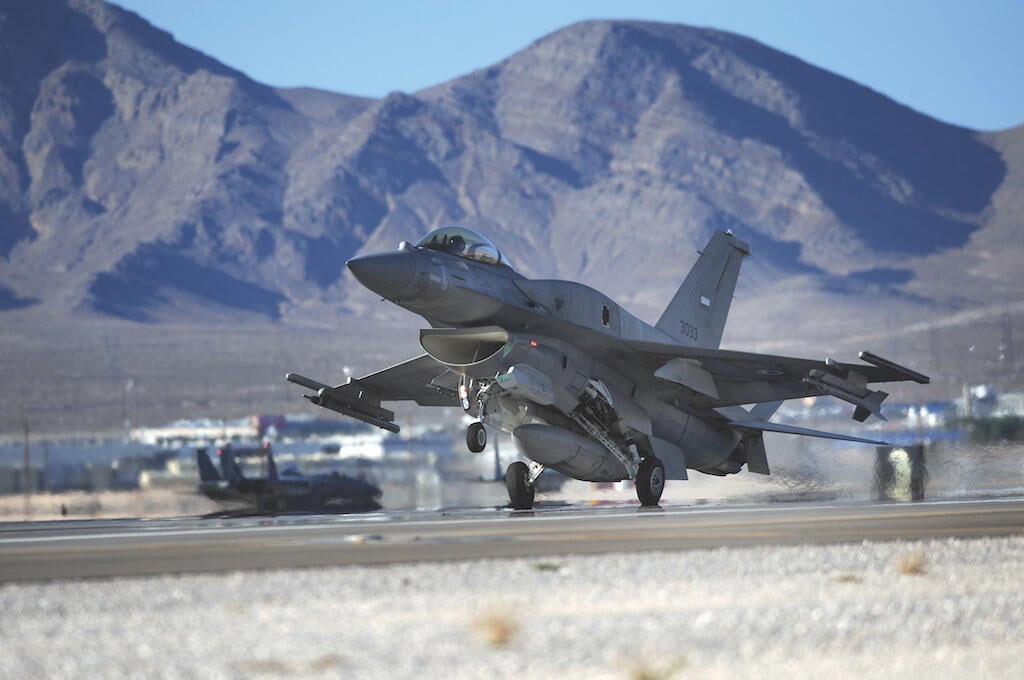
The Air Force’s 1970s-era F-16 fighter received F-35 technology as part of a massive fleet-wide overhaul intended to improve targeting, attack precision, and computer systems enhancements—to extend the fighter’s combat life all the way into the 2040s.
It may be challenging to imagine that today’s Air Force F-16 dates back to the 1970s, a circumstance that might lead some to wonder how the combat aircraft has maintained its combat relevance and performance capacity in the dynamic threat environment of the 2020s.
F-16 Logo on F-16A in NYC
F-16 Logo on F-16A in NYC. Image Credit: National Security Journal.
F-16 Fighting Falcon Onboard USS Intrepid
F-16 Fighting Falcon Onboard USS Intrepid. Image Taken on September 18, 2025.
F-16 Fighting Falcon National Security Journal Photo
F-16 Fighting Falcon National Security Journal Photo. Taken on 9/18/2025 Onboard USS Intrepid.
The answer is actually quite extensive and dates back many years to the inception and preservation of an F-16 Service Life Extension Program, which upgraded the upper wing skin and fittings, adjusted the bulkhead and canopy, and equipped the aircraft with an F-35 Active Electronically Scanned Array (AESA).
AESA Radar
With AESA, the F-16 incorporated an entirely new ability to find, detect, and track enemy threats at much greater ranges.
The aim of the Service Life Extension Program (SLEP) was to extend the flight time of F-16s from roughly six to seven thousand flight hours to 8,000 or more flight hours.
On top of that, the service’s confidence in the upgrades has led to a plan to have the F-16 fly all the way out to 12,000 hours.
The AESA radar, which Lockheed developers say can track up to 20 targets at once, is a massive upgrade over the F-16’s previous mechanically scanned radar.
By virtue of its ability to track multiple targets, the AESA radar can scan a 360-degree sphere, including horizontal, vertical, and diagonal vectors.
New F-16 Cockpit
Not surprisingly, the F-16 has also received new cockpit avionics in recent years, including moving map displays, cockpit video, and digital graphics screens, as well as new target-tracking systems.
Upgraded F-16s also use a high degree of increased on-board automation to free up pilot focus and workload.
By automatically performing a range of critical procedural functions independently, a pilot is freed up to focus more intently on other mission-critical tasks.
Alongside the Air Force SLEP, Lockheed Martin has also been developing a new F-16v variant, which continues to inspire interest from allies around the globe.
The F-16v also uses new computers and software, along with a high-definition cockpit display.
The “V” model also adds a new data bus, an electronic warfare suite, a missile warning sensor, and a helmet-mounted cueing system.
New F-16 Targeting
Not only does the F-16v incorporate AESA, but it also integrates a high-tech, next-generation targeting system called Infrared Search and Track (IRST). IRST, which is used extensively in F/A-18 Super Hornets, is a passive, long-range sensor that searches for and detects infrared emissions.
Much like the AESA, the IRST can track multiple targets at once and operate in an electromagnetic warfare environment.
NATO F-16 Fighter
A U.S. Air Force F-16 Fighting Falcon assigned to the 480th Fighter Squadron taxis at the 86th Air Base, Romania, in support of NATOs enhanced Air Policing (eAP) capabilities, Sept. 22, 2023. European partners and U.S. forces continue to conduct engagements and multinational exercises, which enhance interoperability to improve regional cooperation, maritime security and stability in the region. (U.S. Air Force photo by Airman 1st Class Albert Morel)
As a passive, long-range sensor able to provide air-to-air targeting, IRST introduces new combat variables for the F-16.
In effect, while there are ultimately limits to how much an older aircraft can be upgraded, today’s F-16 is almost an entirely different airplane apart from keeping its basic airframe configuration.